
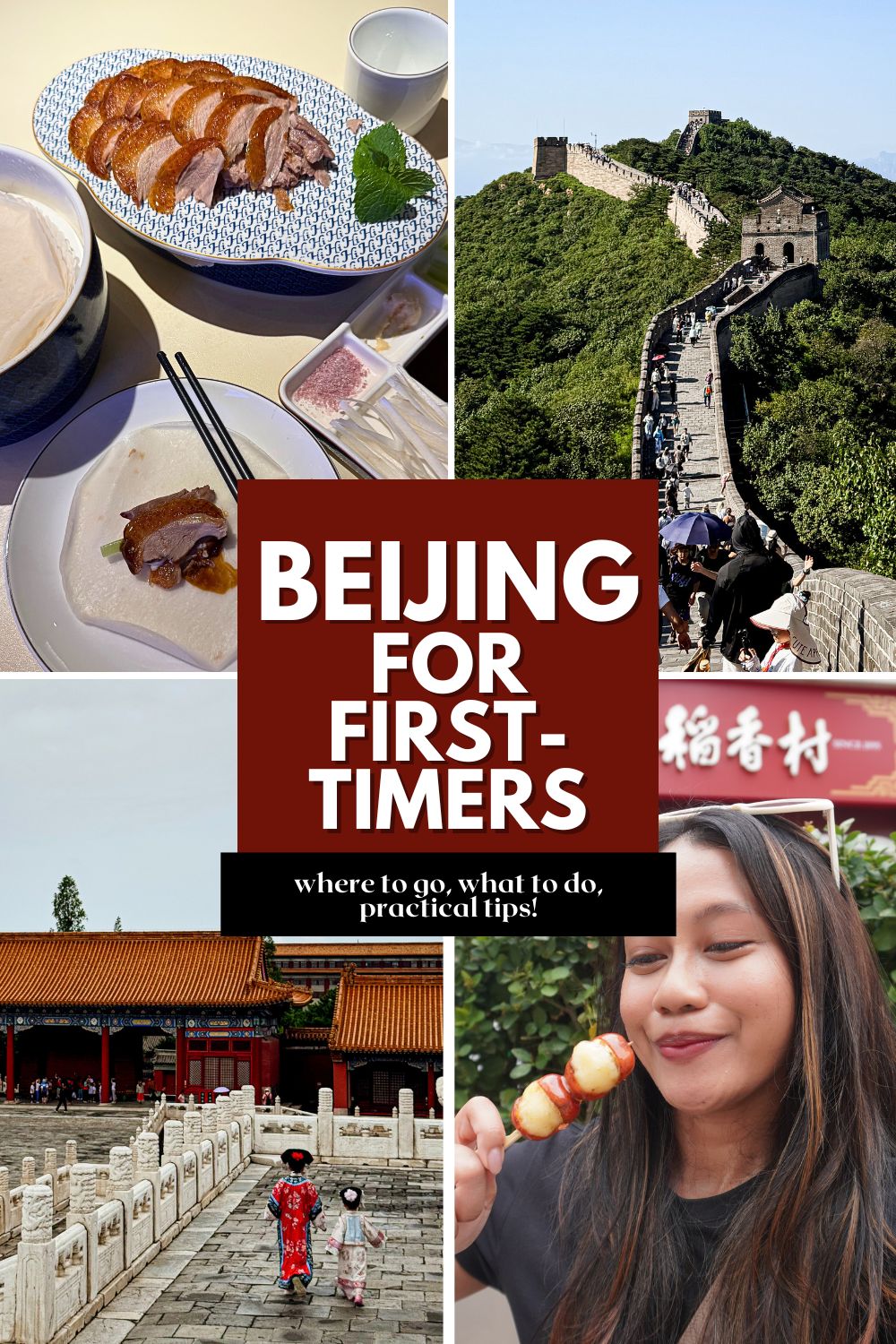
Visiting Beijing soon? This ultimate guide covers top attractions, food hotspots, cultural musts, and handy travel tips.
Introduction
I’m fresh off my trip to Beijing, China, and wow, it surprised me in the best way possible. Honestly, I thought it might be too overwhelming, maybe even… intimidating? I don’t speak Mandarin, I’d heard about China’s restricted apps, and I wasn’t sure how easy it would be to get around. How would I survive? Turns out, not only did I survive, I thrived.
Beijing is a city of contrasts. One moment you’re standing in front of centuries-old temples and imperial palaces, the next you’re weaving through neon-lit streets, snack in hand, watching the city come alive. It isn’t just about sightseeing—it’s about tasting, wandering, and soaking in a culture that blends the old and the new so seamlessly.
What I found was a city that welcomed me with incredible food, fascinating neighbourhoods, and an energy that pulls you right in.
I spent 6 days and 5 nights in Beijing, which gave me time to explore at a more relaxed pace. But if you’re short on time, you can easily cover the major highlights in fewer days—that’s why I’ve included an ideal itinerary in this guide.
So whether it’s your very first trip to China or you’re simply curious about what makes Beijing so special, here’s everything I learned—essential tips, what to see, what to eat, and how to make the most of your time in this vibrant city.
Essential: Apps & Payments
Beijing is a Cashless Society
Beijing is one of the most cashless cities I’ve ever visited. In fact, it was so cashless that I ended up not using any cash at all.
Well, technically I did bring some Singapore dollars with me, thinking I’d exchange them when I landed. But here’s the thing—money changers don’t really exist in Beijing. If you need local currency, you’ll have to change cash at a bank (which isn’t always convenient) or withdraw from an ATM.
I couldn’t be bothered to do either, so I decided to go fully cashless… and I had zero issues. Everything from restaurants to street food vendors to metro rides could be paid for with just your phone!
That said, most places still accept cash. Just be warned that they may not have proper change for you.
Apps to Download Before Your Trip
1. Alipay (a must!)
Alipay is king in Beijing—it’s the main payment method, and almost everyone uses it. Even the smallest street vendor will be able to use the Alipay system.
The best part is that international travelers can now link their foreign credit cards directly to Alipay, so you don’t need a Chinese bank account. The app also comes with an in-built translator, which makes it much easier to navigate menus, shops, and even conversations.
Inside Alipay you’ll also find useful “mini apps”:
- 🚖 Didi (China’s Uber equivalent) – great for rideshares and taxis without language barriers.
- 🚇 Public Transport app – allows you to tap in/out of the metro, buses, and even taxis, without needing a separate transport card.
- 🍜 Meituan or Eleme – food delivery apps (super handy if you want to order in or see what’s nearby). You’ll need to download these apps manually.
2. Translation App
Alipay has its own built-in translation function, but I found it easier to use a separate translation app. Since I usually had Alipay open for payments or navigation, it was much more convenient to quickly switch between apps rather than constantly exiting and re-entering Alipay just to use its translation tool.
Google Translate works if you use an international e-Sim, otherwise download the offline Chinese pack. Otherwise Pleco comes highly recommended too (more accurate for menus, ingredients, and signs).
3. Map App
Google Maps is unreliable in China. Use A Map, Baidu Maps or Gaode (AutoNavi) instead—both are available in English. If you have an iPhone, the Maps app works too.
4. Optional (Nice-to-Have) Apps
- Dianping (like Yelp, but for China) and Xiaohongshu/Rednote (like Instagram + reviews). Both are useful if you can read some Chinese or don’t mind auto-translate.
- WeChat – I only used this once, when my hotel sent me the address in Chinese characters. Otherwise, I didn’t need it at all. Wechat can also be used to order food in restaurants, or to pay as well, but not necessary if you already have Alipay set up.
The Ideal 4–5 Day Itinerary
Here’s my ideal Beijing itinerary! It starts off strong so you can dive right into the sights and experiences.
You can easily space out the activities if you have more days. I’ve left out arrival and departure days since those will depend on your travel schedule. A quick note that this was not how I actually spent my days in Beijing, you can see my actual itinerary in the next section.
Day 1: The Heart of Beijing
We kick things off with the very core of Beijing — history, politics, and imperial grandeur.

Tiananmen Square
The largest public square in the world and an iconic symbol of China. It’s flanked by the Great Hall of the People, the National Museum of China, and Mao’s Mausoleum.
When I went, it was closed for National Day rehearsals. It’s worth checking the website before your visit as closures happen often, and usually without much advance notice. This is even if you’ve booked your tickets with a tour agency.
I didn’t get the chance to visit Tiananmen Square, but we drove past it often. Since direct access isn’t possible, many local tourists rent bicycles and ride past instead. What struck me was that even the bikes had to go through security checks before cycling by the square.
Forbidden City (Palace Museum)

Step into China’s imperial past at the Forbidden City. The complex is HUGE! There are over 900 buildings, so it can feel overwhelming. I highly recommend an audio guide or guided tour. The stories of emperors, concubines, and court life are what make it magical, otherwise the buildings and artefacts just start to look the same.
Don’t forget your passport – this is used as your ‘ticket’ into the museum.
Once you’re done with Forbidden City, end your day at either:
- Beihai Park – A tranquil imperial garden with a lake where you can rent paddle boats. It’s right next to the Forbidden City.
Or
- Jingshan Park – Just behind the Forbidden City, this park offers the best panoramic view of the palace roofs — especially beautiful at sunset.
Or you can do both, but you’ve probably done a lot of walking by now.
Explore Wangfujing and Dinner

To end off the day, take a walk at the nearby Wangfujing, an old-meets-new shopping street to people-watch and hunt down dinner. The typical route is to start from Beijing Hotel and walk down the street until you reach the Catholic Church.
After all that walking, you deserve a hearty dinner.
I recommend having your first taste of Beijing’s most famous dish here: Peking Roast Duck. There are plenty of peking duck restaurants here; a classic spot is Quanjude, but I personally recommend Ziguang Yuan for a Halal and equally delicious option. Ziguang Yuan is also located right past the church.
Want something even heartier? Try the Beijing version of hotpot! I recommend Jubaoyuan Hotpot (九宝源火锅).
Check out my post ‘What to Eat in Beijing’ for more food recommendations!
Day 2: Great Wall of China

“You haven’t really been to China until you’ve climbed the Great Wall.”
The Great Wall of China is about 1–2 hours from central Beijing, so plan a full day. Several sections are accessible from Beijing, we visited the Badaling section. This is the most restored and tourist-friendly. This is where we ended up because Mutianyu was closed due to a landslide.
There’s a north and south side; we visited the south side which had significantly less people than the north. From where we were, we could see the insane dots of people on the north wall! Walk the length of the wall and take lots of pictures.
In summer, the heat can be brutal — we took the cable trolley to save time and energy. Bring water, sunscreen, and good walking shoes!
The other two sections:
- Mutianyu – Scenic, fewer crowds, family-friendly, with a fun toboggan ride down.
- Jinshanling – Best for hiking and photography.
Pro Tip
I joined a group tour that combined Tiananmen Square, the Forbidden City, and the Great Wall all in one day. I highly, highly recommend it. Not only did I save a ton of travel time, but it also made getting through the complicated ticketing system so much easier. Don’t forget to bring your passport! You’ll need it for entry.
Day 3: Old Beijing + Street Food
Today is all about immersing yourself in daily life… and lots of food.
Niujie Mosque & Niujie Food Street

Start your morning in Beijing’s Muslim Quarter, home to the city’s oldest mosque and amazing halal eats (think beef and lamb buns, skewers, hand-pulled noodles).
Amongst all of the street food areas in Beijing, this ended up being my favourite. There’s a variety of food options, and were more well-priced than the more touristy areas like Qianmen and Shichahai.
To work off the food, explore the nearby Niujie Mosque, the largest and oldest mosque in Beijing.
Qianmen Street

A wide pedestrian street just south of Tiananmen. Even though Qianmen is crowded, and may seem inauthentic, there’s plenty of old charm to walk through and admire.
It’s lined with historic shops like Quanjude (the original Peking duck restaurant) and quirky snack stalls. I recommend trying Jasmine Tea ice cream at Wu Yu Tai here. I also had the best lamb skewers here.
Make sure to stop by Metal Hands for the best coffee I had in Beijing!
Shichahai + Drum & Bell Towers

To end the day, head to Shichahai for epic sunsets, and even more street food.
Make your way towards the drum and bell tower first. You can climb the drum tower for sweeping views of Beijing. There will be lots of people taking photos against the towers here. If you’re up to it, you can do a rickshaw bicycle tour.
Then walk towars the Shichahai lake and grab some skewers or dumplings along the way to snack on. End the day by the lakes, where the sunset is absolutely gorgeous against the water backdrop.
If you’re still hungry after all the snacking, or just need a place to rest, there are plenty of restaurants and bars here too.
Day 4: Modern & Creative Beijing (optional or if you have an extra day)
For a change of pace, or a different kind of workout (such as some shopping), I recommend having this day!
798 Art District

This ended up being one of my favourite spots in Beijing! This is a former factory area turned into a hub for contemporary art galleries, design shops, and cool graffiti and murals. Great for photography.
I ended spending so much time here just exploring; I kept chancing upon interesting things at every corner. If you’re looking for souvenirs that are unique and more artsy, you can find plenty of options here too.
Sanlitun
This is a trendy district with international brands, bars, and expat-friendly restaurants. Good for a change of pace if you’ve had your fill of historic Beijing.
I came for the sole purpose of visiting Songmont, a Chinese bag brand, and I ended up staying for longer just wandering the malls.
Panjiayuan Antique Market
If I had just one regret, it’s not making my way to Panjiayuan.
If you love browsing vintage trinkets, ceramics, and antiques, this is the place.
Day 5: Palaces + Parks
Disclaimer: I didn’t manage to do this day, but if you have the time, these two are highly worth visiting.
Summer Palace (Yiheyuan)
A stunning retreat outside the city center so allow for at least 4–5 hours here. The vast gardens, pavilions, and Kunming Lake make it perfect for a half-day visit. Boat rides are especially popular in summer.
Nanluoguxiang Hutong
As you make your way back to the city centre, stop by Nanluoguxiang One of the most famous hutongs (old alleyways). It’s a little touristy, but it’s fun to wander, snack on quirky street foods, and shop for souvenirs.
Temple of Heaven (Tiantan)
Known for its perfect symmetry and colourful Ming architecture. In this itinerary, we will probably visit Temple of Heaven in the evening, but if you happen to visit in the mornings, you may be able to spot local Beijingers practice tai chi, dance, and play music.
My Actual Itinerary (what I really did)
I came without much planning, so this was my actual itinerary, for your reference. I knew that I wanted to take my time and wing it, so I could relax on the trip instead of chasing sights.
It’s also worth noting that I visited in summer, so the weather was unpredictable — it switched often between uncomfortably warm and humid, to sudden showers. I often adjusted my plans on the fly depending on the weather.
- Day 1 – Arrival + First Impression: Evening stroll along Wangfujing Street, Peking duck dinner for my first taste of Beijing
- Day 2 – Chill Day + Shopping: Slept in, ordered breakfast in, explored Sanlitun (mainly to shop at Songmont!), Mongolian hotpot at Jiubaoyuan for dinner.
- Day 3 – Full Day Guided Tour of Beijing’s Must-Sees: Tiananmen Square + Forbidden City, Great Wall of China (Badaling section). An intense day of squeezing in all the sights, but I preferred it so! Wangfujing closed down in the afternoon for the military parade rehearsal, so I stayed in and found a nearby peking duck place that was still open.
- Day 4 – Artsy + Modern Beijing: Slept in (yesterday was an intense full day), and then spent the entire day at 798 Art District – one of my favourite spots in Beijing, and a definite must-visit for a nice change of pace.
- Day 5 – Historic Streets: Qianmen for street snacks, best coffee in Beijing at Metal Hands, and ended the day at Shichahai for the most beautiful sunset.
- Day 6 – Foodie Morning + Rainy Day: Niujie Food Street for breakfast first, and since the rain was incessant, I decided to explore ‘trendy’ malls in Beijing: The Box and Xidan Joy City. I wouldn’t recommend the places, they were very generic malls. Since it was still raining, I had a cozy night in with some takeout.
- Day 7 – Departure Day: Ordered in breakfast, had a last stroll through Wangfujing and ordered food at Renshifujing, and tried Tanghulu. Then it’s bye Beijing! Immigration was a bit stricter than most airports, but extremely quick and efficient.
The Top Attractions in Beijing (In a Nutshell)

Beijing has so much to offer, from ancient landmarks to trendy modern spots. Here’s a quick breakdown of all the sights that we’ve covered and a few extras I have not mentioned:
Must-Sees (First-Time Visitors)
- Forbidden City + Tiananmen Square – The political and cultural heart of China.
- Great Wall of China – Best sections for day trips:
- Mutianyu (scenic, well-preserved)
- Jinshanling (hiking, fewer crowds)
- Badaling (easiest access, but busiest)
Cultural & Historical Gems
- Temple of Heaven – Ming dynasty architecture + locals practicing tai chi in the mornings.
- Summer Palace – A peaceful escape with lakes and gardens (plan half a day).
- Beihai Park – One of the oldest imperial gardens, with a scenic lake and paddle boats.
- Jingshan Park – Famous hilltop with the best panoramic views of the Forbidden City.
- Lama Temple (Yonghe Temple) – A striking Tibetan Buddhist temple.
Local Life & Street Food
- Niujie Mosque + Food Street – Center of Beijing’s Muslim community and amazing halal eats.
- Qianmen Street – Traditional shops mixed with modern stores, just south of Tiananmen.
- Shichahai – Lakeside strolls, street snacks, bars, teahouses, and boat rides. Don’t miss the beautiful sunset here!
- Drum & Bell Towers – Historic landmarks, often paired with Shichahai. Unless you’re entering the landmarks, you’d spend perhaps just 5 minutes here – more if you’re taking plenty of photos like the locals!
- Wangfujing – Perfect mix of shopping + food-hunting. The food street has shut down, so there’s not much street snacks. Head to the Renminshiji food court, which houses all of Beijing’s must-eat dishes under one roof.
- Hutongs (Nanluoguxiang, Gulou) – Charming alleyways with shops, street food, and rickshaws.
Modern Attractions & Entertainment
- 798 Art District – Trendy galleries, cafés, and street art (one of my faves!).
- Universal Studios Beijing – One of the biggest Universal Studios theme park, the one in Beijing has a Harry Potter-themed world.
- Pop Land – If you’re a fan of Pop Mart, you cannot miss Pop Land in Beijing. It’s the world’s very first Pop Mart theme park!
- Olympic Park – Bird’s Nest + Water Cube, magical at night when lit up.
- CCTV Headquarters (“Big Pants”) – A modern architectural icon.
- National Centre for the Performing Arts (“The Egg”) – Futuristic glass dome, great for photos.
Food to Try in Beijing
Beijing is a food paradise, with everything from iconic dishes to comforting breakfasts and irresistible street snacks. Here are some of my must-tries:
🥢 Must-Eats
- Peking Duck (北京烤鸭, Běi jīng kǎo yā) – Crispy skin, tender meat, wrapped with scallions, cucumber, and sweet bean sauce in thin pancakes. A must-have Beijing experience.
- Hotpot (火锅, huǒ guō) – Especially lamb hotpot, with thinly sliced meat cooked at the table in a bubbling broth. Unlike spicy Sichuan hot pot, this version uses a clear broth and relies on the lamb that you dip in to add flavour.
- Zhajiangmian (炸酱面, zhá jiàng miàn) – Hand-pulled noodles topped with fermented soybean paste, often with fresh vegetables.
🌅 Breakfast Classics
- Jianbing (煎饼, jiān bǐng) – A savory crepe filled with egg, scallions, cilantro, crispy wonton, and sauces. Perfect grab-and-go breakfast.
- Youtiao & Doujiang (油条 & 豆浆, yóu tiáo & dòu jiāng) – Fried dough sticks with warm soy milk, a traditional pairing.
- Savory Tofu (豆腐脑, dòu fu nǎo) – Also called “tofu brains,” this silky tofu dish comes topped with a soy sauce-based gravy, chili oil, pickles, and herbs. Comforting and savoury.
- Douzhi (豆汁, Dòuzhī) – Fermented mung bean drink, unique to Beijing… I dare you to try it! An acquired taste but very traditional.
🍢 Street Snacks
- Grilled Lamb Skewers (羊肉串, yáng ròu chuàn) – A popular Muslim street food, seasoned with cumin and chili.
- Tanghulu (糖葫芦, táng hú lu) – Skewered hawthorn berries (or strawberries, grapes) dipped in hard caramelized sugar.
- Baozi (包子, bāo zi) – Steamed buns with various fillings like pork, beef, or vegetables.
- Roujiamo (肉夹馍, ròu jiā mó) – Often called the “Chinese hamburger,” with braised meat stuffed into a flatbread.
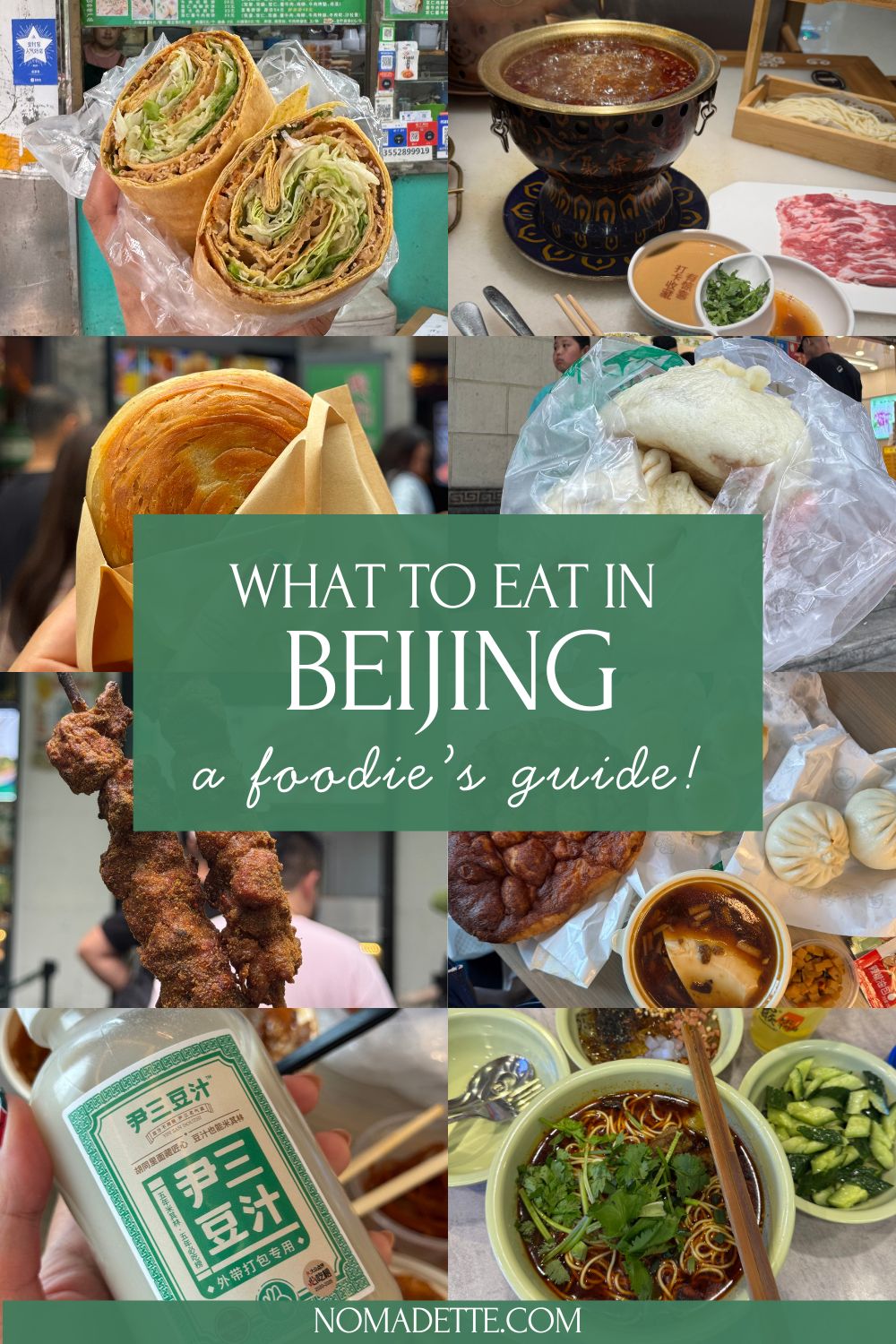
All the Must-Eats!
What to eat in Beijing?
Want a full deep dive into the food scene? Check out my Foodie’s Guide to Beijing – including how to order food delivery!
Dietary Restrictions?
No matter your dietary restrictions, it’s easy to find food in Beijing. A quick tip is to save the Chinese words (both pinyin + characters) on your phone to show restaurant staff—it makes ordering much easier.
- Halal (清真, qīng zhēn) – Beijing has a large Muslim population, so you’ll find plenty of halal restaurants and snacks, especially around Niujie (Ox Street).
- Vegetarian (素食, sù shí) – You can find plenty of vegetarian dishes in Beijing. To be sure, make sure to ask staff if items are vegetarian. Veganism may not be as widespread in Beijing, but fully vegan dishes are not hard to find. I’ve also heard of Buddhist restaurants that offer creative vegetarian and vegan takes on traditional dishes.
Where to Stay in Beijing
Choosing the right neighborhood in Beijing makes a huge difference to your trip. The city is massive, and traffic can be unpredictable, so being well-located saves you a lot of time (and stress).
I made all my bookings on Trip.com. Here are the main areas I recommend:
Wangfujing / Dongcheng (Best for First-Timers)
This is where I stayed, and I can’t recommend it enough. Wangfujing is central, within easy reach of major sites like the Forbidden City, Tiananmen Square, and the hutongs. More importantly, it’s surrounded by good food. The snack street has unfortunately closed down, but you’ll still be able to find plenty of food options in Wangfujing.
What I love about Wangfujing is that it balances old and new. You get the atmosphere of ancient China while still having the conveniences of modern facilities. Yes, it’s touristy, but that’s not a bad thing for first-timers. It means everything feels easier and more accessible.
Hotels in Wangfujing I’d recommend (based on location & accessibility):
- FONTOO Beijing – I stayed here for my visit. It’s a new hotel: spacious, modern rooms, and modern touches like a robot that delivers bottled water to your room (!). Downsides: the hotel lobby is on the 3rd floor with no proper entrance, which was inconvenient in the rain or with luggage.
- Crystal Orange – Stylish, mid-range hotel with great reviews for comfort and location.
- Cofizz Hotel – Trendy, minimalist design, good for younger travelers.
- Atour Hotel – My top pick here, since it’s literally on Wangfujing Shopping Street. Ultra-convenient if you want everything right at your doorstep.
- Jianguo Hidden Hotel – Chic, boutique-style stay with a quieter vibe.
- Sunworld Hotel – A reliable, budget-friendly option near the action.
Chaoyang / Sanlitun (Best for Shopping & Nightlife)
If you prefer a more modern, international vibe, stay in Sanlitun. This area is full of global brands, shopping malls, and trendy restaurants. Food options are plentiful, including international cuisines if you want a break from Chinese food. It’s also Beijing’s nightlife hub, with rooftop bars and expat-friendly spots.
Compared to Wangfujing, traffic here felt less painful. It’s not as close to the historic sites, but if your focus is shopping, dining, and nightlife, it’s a great base.
Hutongs (Best for Culture Seekers)
For a more immersive stay, consider a boutique hotel or guesthouse inside a hutong (Beijing’s traditional alleyways). These are often converted from old courtyard homes, giving you a unique cultural experience.
The downside? Many hutong hotels aren’t directly accessible by taxi or Didi, so you may need to walk from the main road with your luggage. Depending on the location, food and conveniences might also be limited late at night.
That said, if you want to wake up to historic Beijing outside your door, it’s magical.
Best hutong areas to stay in would be Qianmen and Shichahai.
- CitiGO Qianmen – Located at a tail end of Qianmen, a lively area south of Tiananmen Square, and with easy metro access. Lots of shops, restaurants and street snacks here! Great if you want the hutong atmosphere but still want convenience.
Pro tip
If it’s your first trip to Beijing, I’d recommend starting with Wangfujing. Once you’re more comfortable with the city, try staying in a hutong for a different perspective.
Getting Around Beijing
Airports + Transport Tips
When I first landed in Beijing, I booked a hotel transfer to keep things simple. In hindsight, it probably wasn’t necessary—getting a ride from the airport is straightforward, even with the massive crowd. It can feel a little overwhelming at first, but I was pleasantly surprised by how orderly everything was.
Once settled into my hotel, I ended up taking Didi (China’s version of Uber) everywhere. It’s incredibly convenient and affordable. One feature I loved is that you can chat with your driver on the app before the ride, and the built-in translation tool will automatically translate your notes for them.
That said, the subway system in Beijing is amazing. My hotel sat right above a subway station, so I decided to give it a try—and honestly, it couldn’t have been easier. I used Amap to figure out my routes, and instead of buying tickets, I simply scanned in using the Alipay app. No fumbling with machines or cash! The subway ended up being my go-to, especially during peak hours when traffic gets heavy. It was quick, seamless, and probably the best way to get around the city.
To summarise:
- Subway:
- Cheap, efficient, and covers most attractions.
- Signage is in both Chinese and English, so it’s easy for tourists.
- Best way to avoid traffic, which can get hectic during peak period.
- Taxi / Didi:
- My main mode of transport were Didi, China’s version of the rideshare app. It’s super affordable.
- You can also grab a taxi on the side of the road, you can easily pay via Alipay. However, drivers may not speak English → always have your destination written in Chinese, or prepared on your translation app.
- Didi app (set to English mode) makes life much easier.
- Walking & Cycling:
- Hutongs and central areas are very walkable.
- May not be the most tourist-friendly, but if you’re up for it, try the bicycles! Beijing has plenty of public bikes available for rent via the Alipay app.
- Airport Transfers:
- I booked an airport transfer on Trip.com, it was easy and affordable! I’m sure it would have been easy to book a Didi or taxi when you land with no issues though.
- There’s also the Airport Express train, for the fastest way into the city from PEK.
Practical Tips for First-Timers in Beijing
Traveling to Beijing can feel overwhelming at first, but with a little prep, your trip can go much more smoothly. Here are some key tips I wish I knew before going:
1. Tours Are Worth It (With Caveats)
- Beijing is massive and navigating attractions on your own can get confusing. Online ticket systems are inconsistent (sold out online, but maybe available onsite), and entrances aren’t always easy to find.
- Booking a guided tour saved me so much stress. Not only did I skip the complicated ticketing process, but I also learned the history behind each landmark—which made everything more meaningful.
- 🚐 Bonus: Tours often include comfy transport, saving hours of travel time.
Pro TiP!
Look for tours that say “No Shopping Stops”. These cost a bit more but save you from wasted time (and frustration) of waiting around.
🌤️ 2. Best Time to Visit
- Spring (April–May) and Fall (September–October) are the most pleasant: mild weather and clearer skies.
- Summer (June–August): Hot, humid, with sudden rain showers. I visited in August—worst timing! It was also school holidays, so crowds were extra overwhelming.
- Winter (December–February): Bitterly cold but fewer tourists.
- ⚠️ Avoid major holidays (like National Day, Oct 1st). Attractions are closed not only on the day of, but in the weeks leading up to it with little notice for parade rehearsals. I couldn’t visit Tiananmen Square because of this.
🗣️ 3. Language Barriers
- Around 90% of locals don’t speak English, so be prepared!
- Locals are helpful though, and translation apps bridge the gap.
- Alipay has a built-in translator, but I preferred a separate app so I could toggle between apps easily.
Pro Tip
Save key phrases and Chinese characters (e.g., “toilet,” “vegetarian,” or your hotel address) on your phone for quick reference.
🌐 4. Internet & VPN
- The usual apps we rely on (Google, WhatsApp, Instagram, Facebook) are blocked in China.
- To bypass this, there are a couple of options:
- International eSIM: This was what I used—super smooth! I was able to use all the restricted apps with no issues.
- Standalone VPN: Popular option, and it worked when I tried. However since the eSim function was far more convenient, I did not have to turn it on.
- Local apps like Alipay, WeChat, Amap (Gaode) work perfectly once you set them up, no matter the network used.
My Takeaway from Beijing
Beijing honestly took me completely by surprise. Beyond the layers of history and culture, what struck me most was just how modern, convenient, and well-connected the city is—it’s an attraction in itself. I found myself walking more here than in any other city I’ve visited, and each step uncovered something new, from tucked-away eateries to bustling neighborhoods.
The food scene was a whole adventure on its own, filled with flavours I’d never experienced before.
And perhaps what I’ll remember most: the people – from the Didi drivers, the wait staff and the locals who patiently entertained my broken Chinese. Kind, helpful, and genuinely welcoming, they made me feel at home in a city so vast.
Beijing is so much more than the Great Wall or the Forbidden City—it’s a place that stays with you long after you leave.
I can’t wait to visit China again! I definitely want to try a 24 hour spa. Anyone?